


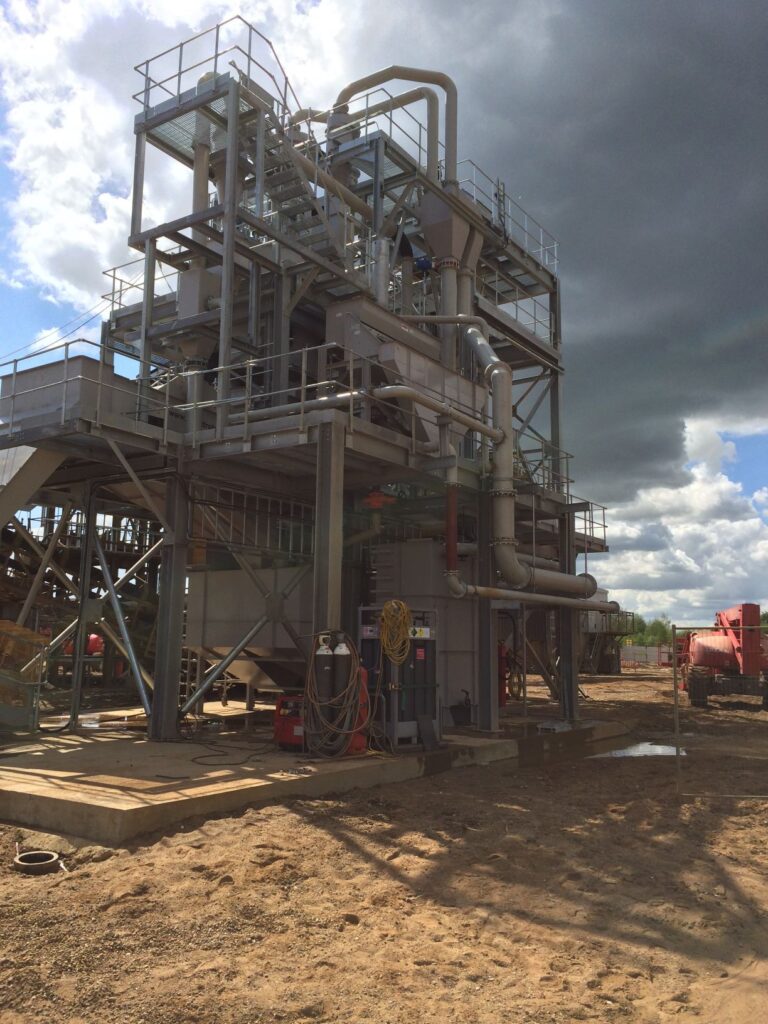
In 2013, MEP were selected to supply a Single Stage Deligniting Plant to Breedon Aggregates (now Breedon Southern) at Norton Bottoms Quarry, Norton Disney, Lincolnshire.
The brief was to supply a sand washing plant with a capacity of 200 t/h, remove the coarse lignite and produce a clean washed concrete sand. The brief also included the need to maximise concrete sand production with excess fine sand de-watered with the existing fine sand tower.
Lignite is a containment contained within the raw material which, in the past, has caused major problems for the operator and has been a barrier to sales from the site.
The plant was supplied for erection by Breedon Aggregates’ main contractor together with a free issued de-watering screen.
The contract included transportation to site, supervision of installation and commissioning.
The sand plant was delivered on schedule with installation and commissioning taking place during the summer of 2014.
It has proved possible to produce 100% clean concrete sand without the need to produce a mortar sand.
The Process
The process was designed to handle up to 200 t/h of < 5 mm sand and produce a concreting and residual sand products.
The plant was configured to remove the > 0.70 mm deleterious matter.
The sand and water slurry is pumped using a centrifugal slurry pump to two Primary Cyclones where it is partially dewatered and de-slimed.
The underflow from the Primary Cyclones reports to the TBS 2400 Hydrosizer. The overflow is made available for balancing the primary sump and any excess reports to the effluent tank.
The TBS 2400 Hydrosizer separates the sand at approximately 0.30 – 0.40 mm, with the clean coarse sand particles discharging to the concrete sand de-watering screen. The fine particles, together with the lignite passes over a static 3.0m Sieve Bend.

The coarser lignite is rejected by the 3.0m Sieve Bend and passes directly into the effluent tank, the fines and water reports to the secondary sump.
The sand and water slurry collected in the combined underpan of the concrete sand dewatering screen and the secondary sump is pumped using a centrifugal slurry pump to the Secondary Cyclone where it is partially dewatered.
The underflow from the Secondary Cyclone reports to the concrete sand de-watering screen.
The concrete sand is dewatered using an inclined Sand Screen and stockpiled using a radial conveyor.
The excess fines are de-watered using the plants existing fine sand system.
The Cyclone overflows reports to the Water Control Boxes where possible it is recycled to maintain the sump level and optimise water and power consumption.
The excess water, together with silts and clays, overflow the Water Control Boxes and report to the adjacent Effluent Tank.
The effluent is pumped by a centrifugal pump to the MEP Ø8.0m Thickener.
The Thickener is dosed with a liquid flocculant supplied by a MEP Polymer Make-Up Unit (PMU) to accelerate the solids settling process within the Thickener.
The thickened sludge will underflow the Thickener and is either pumped to the Dewatering Screens where is mixed with the sand product or an option to bypass the screens is available to site.
The clean water overflowing the Thickener flows by gravity to the adjacent Clean Water Tank which is then pumped by a centrifugal pump to the plant spray bars.